What Do the Sides of a Triangle Add Up to
Eugene is a qualified control/instrumentation engineer Bsc (Eng) and has worked as a programmer of electronics & software for SCADA systems.
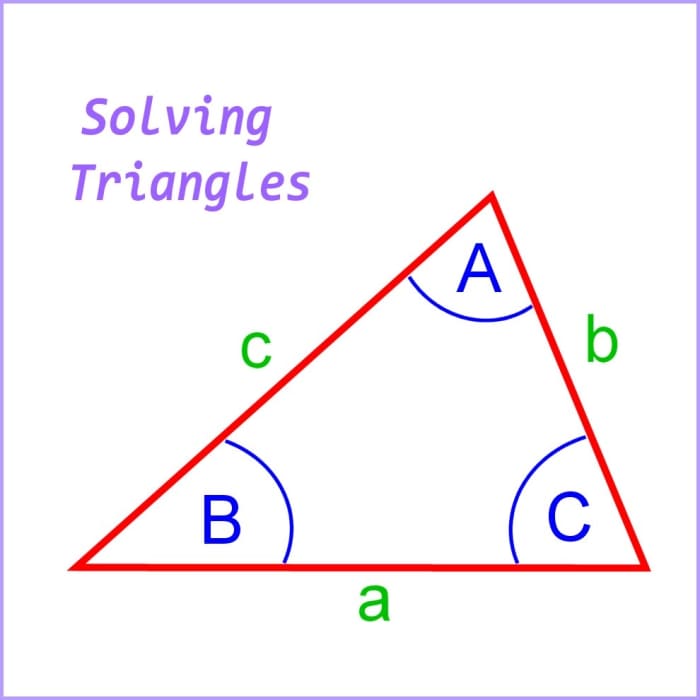
Solving triangles
© Eugene Brennan
Trigonometry and Triangles
In this tutorial, y'all'll learn almost trigonometry which is a branch of mathematics that covers the relationship between the sides and angles of triangles.
We'll find out almost:
- Polygons and the Definition of a Triangle
- The Basic Facts About Triangles
- The Triangle Inequality Theorem
- Different Types of Triangles
- Using the Greek Alphabet for Equations
- Sine, Cosine and Tangent
- Pythagoras'due south Theorem
- The Sine and Cosine Rules
- How to Work Out the Sides and Angles of a Triangle
- Measuring Angles
- How to Calculate the Area of a Triangle
What Is a Triangle?
By definition, a triangle is a polygon with iii sides.
Polygons are plane shapes with several straight sides. "Aeroplane" just means they're flat and 2-dimensional. Other examples of polygons include squares, pentagons, hexagons and octagons. The give-and-take plane originates from the Greek polús meaning "many" and gōnía meaning "corner" or "bending." And so polygon means "many corners." A triangle is the simplest possible polygon, having only three sides.
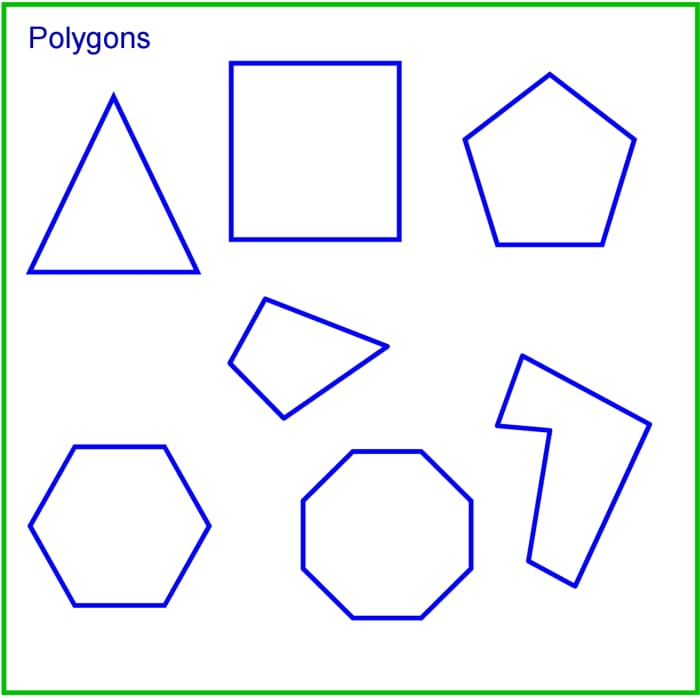
Polygons with different numbers of sides. Regular polgons have sides the same length.
© Eugene Brennan
Basic Facts About Triangles
- A triangle is a polygon with three sides.
- All the internal angles add together up to a total of 180 degrees.
- The angle between two sides can be annihilation from greater than 0 to less than 180 degrees.
- The angle between 2 sides can't be 0 or 180 degrees, because the triangle would so go directly lines. (These are called degenerate triangles).
- Similar triangles take the same angles, simply different length sides.
The Symbol for Degrees
Degrees tin be written using the symbol º. And so, 45º means 45 degrees.
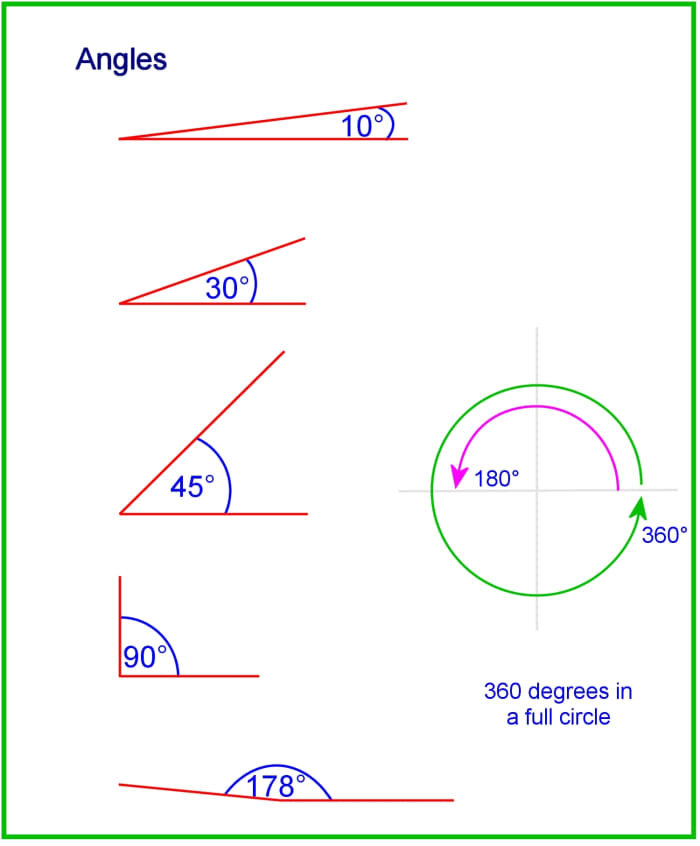
Angles of a triangle range from 0 to less than 180 degrees.
© Eugene Brennan
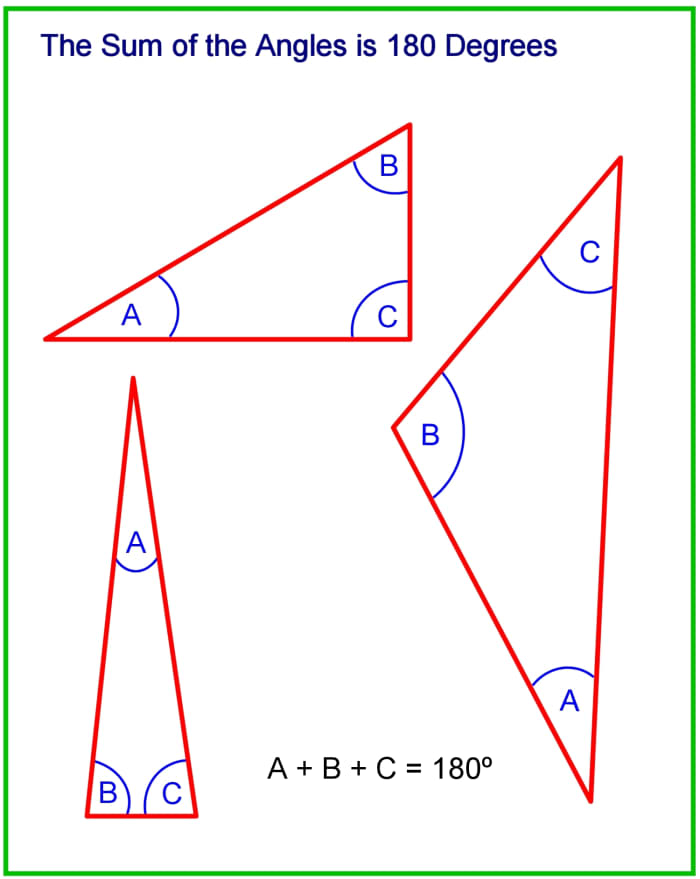
No thing what the shape or size of a triangle, the sum of the iii internal angles is 180
© Eugene Brennan
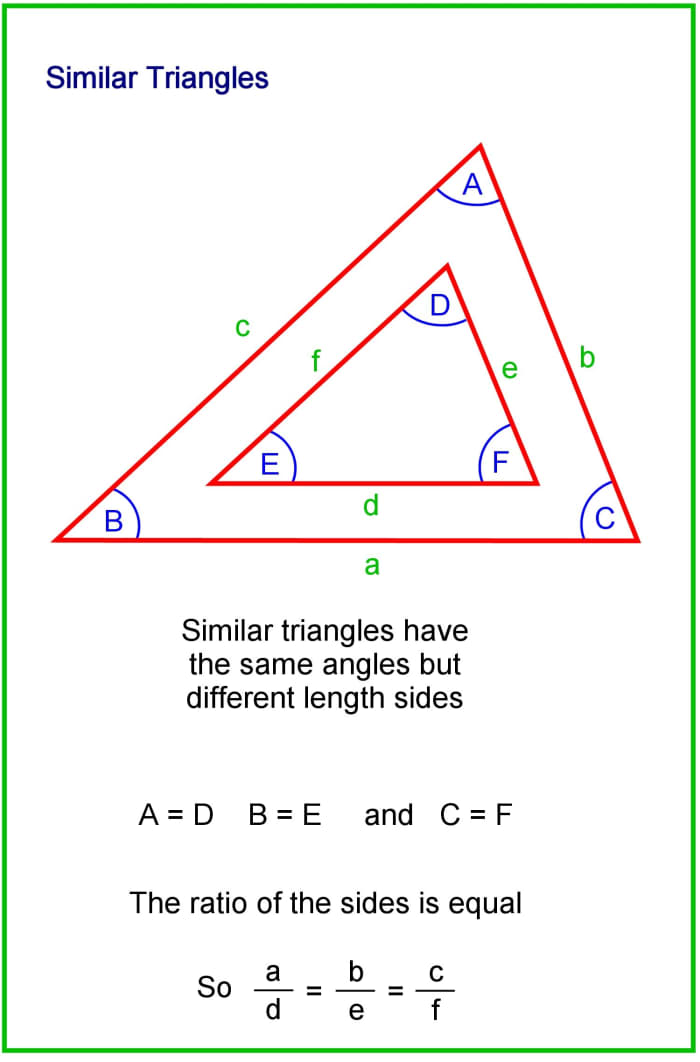
Similar triangles have the aforementioned angles but different length sides.
© Eugene Brennan
What Is the Triangle Inequality Theorem?
This states that the sum of whatever two sides of a triangle must be greater than or equal to the remaining side.
What Are the Different Types of Triangles?
Earlier nosotros learn how to work out the sides and angles of a triangle, it'due south important to know the names of the different types of triangles. The classification of a triangle depends on two factors:
- The length of a triangle'south sides
- The angles of a triangle'south corners
Scroll to Continue
Read More From Owlcation
Types of Triangles Past Sides and Angles
You can allocate a triangle either by side length or internal bending.
| Type of Triangle past Lengths of Sides | Description |
|---|---|
| Isosceles | An isosceles triangle has two sides of equal length, and i side that is either longer or shorter than the equal sides. Angle has no bearing on this triangle type. |
| Equilateral | All sides and angles are equal in length and caste. |
| Scalene | All sides and angles are of unlike lengths and degrees. |
| Type of Triangle by Internal Bending | Description |
|---|---|
| Right (right angled) | I angle is 90 degrees. |
| Acute | Each of the three angles mensurate less than 90 degrees. |
| Birdbrained | I angle is greater than xc degrees. |
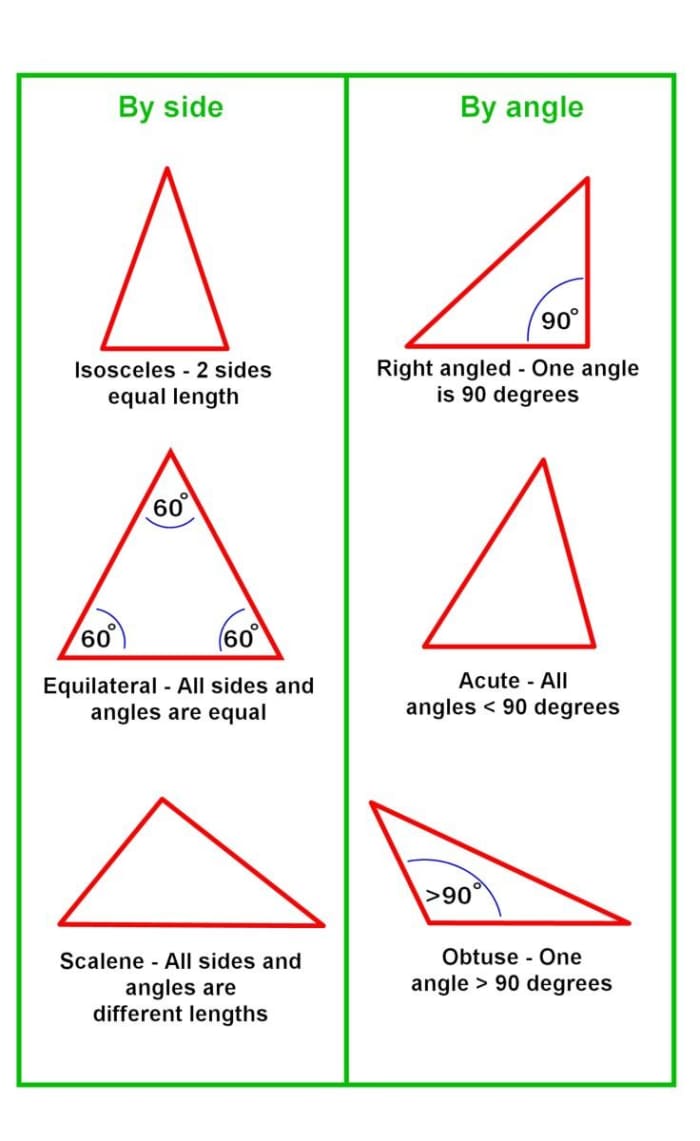
Triangles classified by side and angles.
© Eugene Brennan
Using the Greek Alphabet for Equations
Another topic that nosotros'll briefly embrace earlier we delve into the mathematics of solving triangles is the Greek alphabet.
In science, mathematics, and engineering many of the 24 characters of the Greek alphabet are borrowed for employ in diagrams and for describing certain quantities.
You may have seen the grapheme μ (mu) represent micro as in micrograms μg or micrometers μm. The majuscule letter Ω (omega) is the symbol for ohms in electric engineering. And, of course, π (pi) is the ratio of the circumference to the diameter of a circle.
In trigonometry, the characters θ (theta) and φ (phi) are frequently used for representing angles.
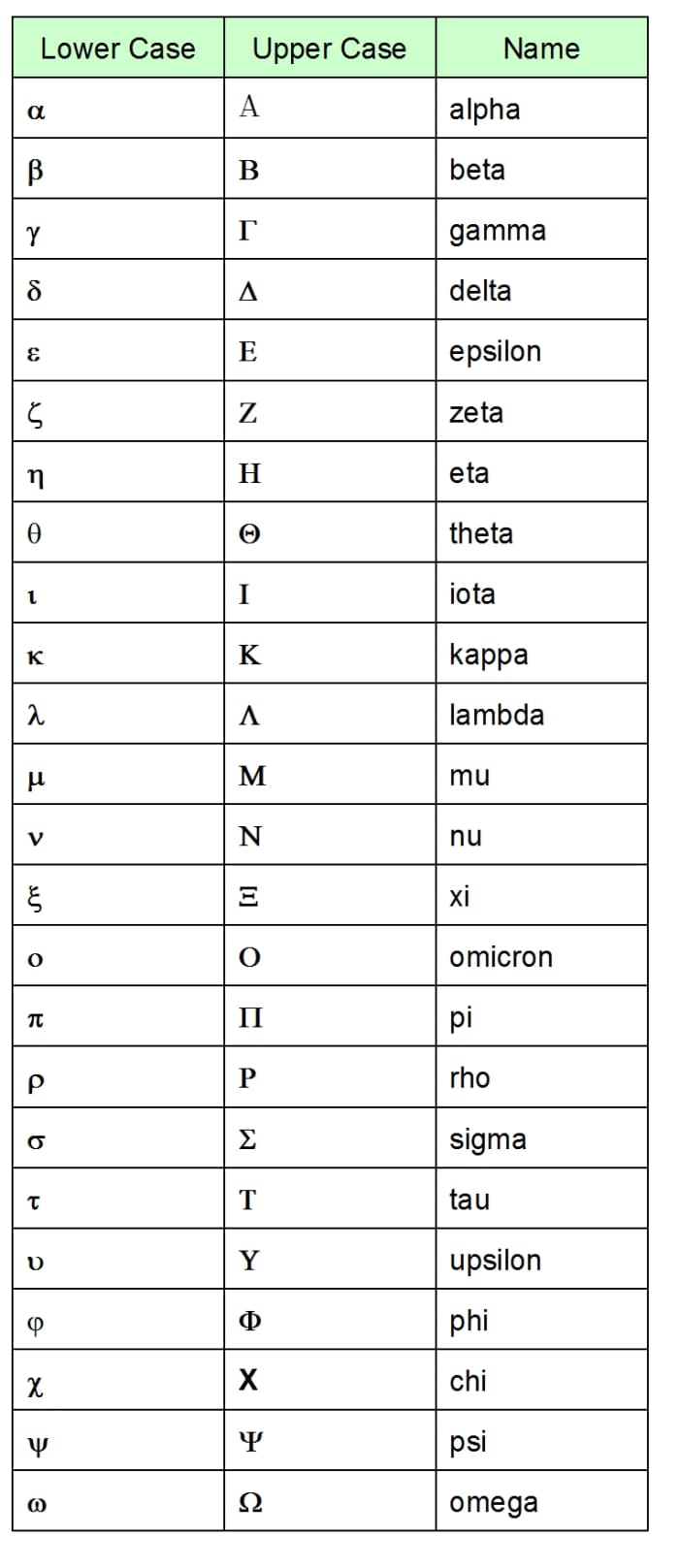
Letters of the Greek alphabet.
© Eugene Brennan
How Do You Find the Sides and Angles of a Triangle?
There are several methods for working out the sides and angles of a triangle. To find the length or angle of a triangle, ane can use formulas, mathematical rules, or the fact that the angles of all triangles add upward to 180 degrees.
Tools to discover the sides and angles of a triangle
- Pythagoras's theorem
- Sine rule
- Cosine rule
- The fact that all angles add together upwardly to 180 degrees
Pythagoras'due south Theorem (The Pythagorean Theorem)
Pythagoras'southward theorem uses trigonometry to discover the longest side (hypotenuse) of a right triangle (right angled triangle in British English). It states that for a correct triangle:
The foursquare on the hypotenuse equals the sum of the squares on the other two sides.
If the sides of a triangle are a, b and c and c is the hypotenuse, Pythagoras's Theorem states that:
c 2 = a ii + b ii
c = √(atwo + b 2)
The hypotenuse is the longest side of a right triangle, and is located contrary the right angle.
So, if you know the lengths of 2 sides, all you have to do is square the ii lengths, add together the result, so accept the foursquare root of the sum to go the length of the hypotenuse.
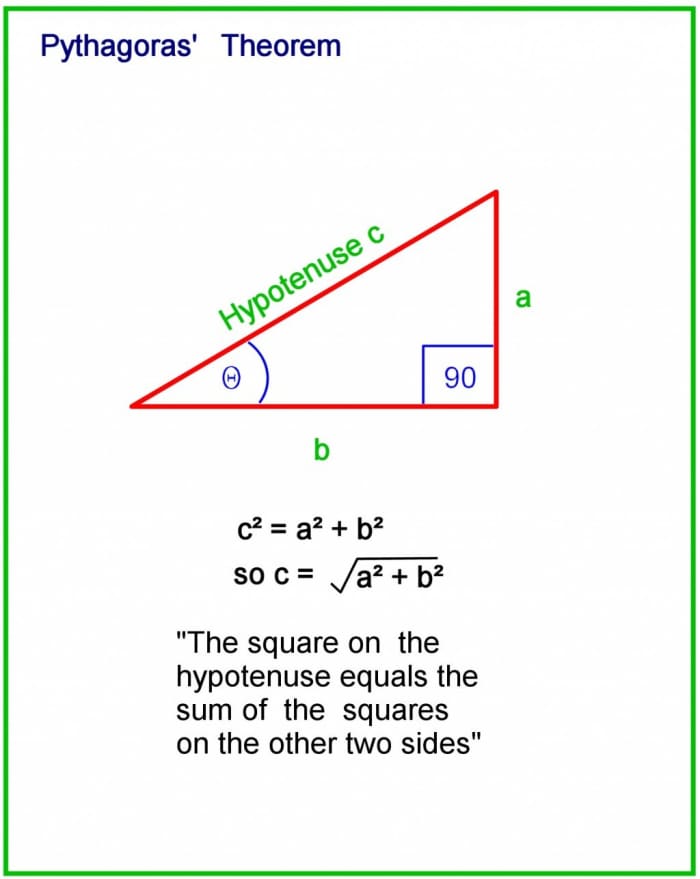
Pythagoras'due south Theorem
© Eugene Brennan
Instance Problem Using the Pythagorean Theorem
The sides of a triangle are three and four units long. What is the length of the hypotenuse?
Call the sides a, b, and c. Side c is the hypotenuse.
a = three
b = 4c = Unknown
So, according to the Pythagorean theorem:
c2 = a2 + b 2
And then, c2 = 3two + 4two = 9 + sixteen = 25
c = √25
c = five
How Do You Measure Angles?
You lot tin can use a protractor or a digital bending finder like this 1 from Amazon. These are useful for DIY and construction if y'all demand to measure an angle between 2 sides, or transfer the bending to some other object. Yous tin utilize this as a replacement for a bevel gauge for transferring angles eastward.g. when marking the ends of rafters before cut. The rules are graduated in inches and centimetres and angles tin can exist measured to 0.1 degrees.
Note that this isn't suitable as a technical drawing instrument because the hub won't sit flat on paper unlike a protractor. Also since information technology's fabricated of stainless steel, it has pointed corners which may be precipitous and therefore isn't suitable for immature children.
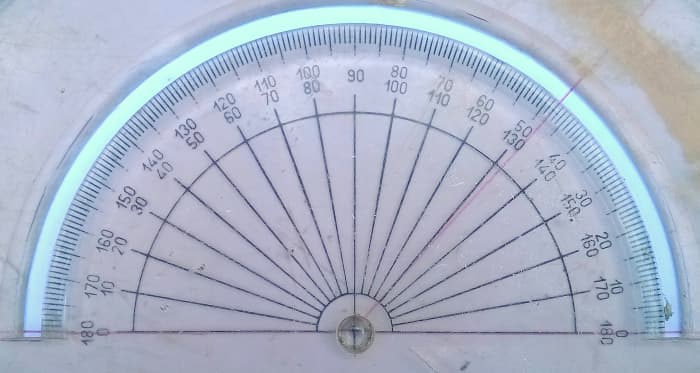
You can describe and measure angles with a protractor.
© Eugene Brennan
Sine, Cosine and Tangent of an Bending
A right triangle has one angle measuring 90 degrees. The side opposite this angle is known every bit the hypotenuse (another name for the longest side). The length of the hypotenuse can be discovered using Pythagoras's theorem, just to discover the other two sides, sine and cosine must exist used. These are trigonometric functions of an angle.
In the diagram beneath, ane of the angles is represented by the Greek alphabetic character θ. (pronounced "the - ta"). Side a is known equally the "opposite" side and side b is chosen the "adjacent" side because of their positions relative to the angle θ.
The vertical lines "||" around the words below mean "length of."
So sine, cosine and tangent are defined as follows:
sine θ = |opposite side| / |hypotenuse|
cosine θ = |adjacent side| / |hypotenuse|
tan θ = |opposite side| / |adjacent side|
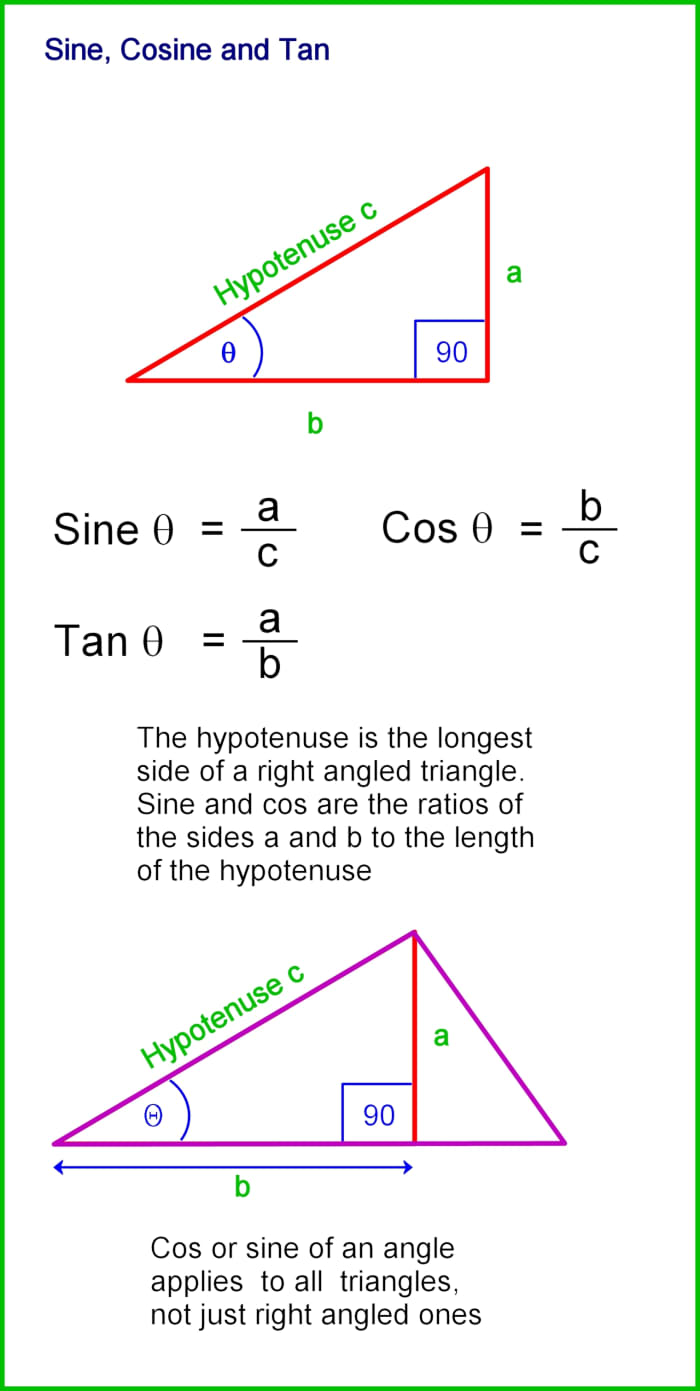
Sine, cosine and tan.
© Eugene Brennan
Sine and cosine utilise to an bending, any angle, then information technology'due south possible to take 2 lines meeting at a point and to evaluate sine or cosine for that angle fifty-fifty though at that place'south no triangle as such. Withal, sine and cosine are derived from the sides of an imaginary correct triangle superimposed on the lines.
For instance, in the second diagram higher up, the purple triangle is scalene not correct angled. Withal, you lot tin imagine a right-angled triangle superimposed on the purple triangle, from which the opposite, adjacent and hypotenuse sides can be determined.
Over a range 0 to ninety degrees, sine ranges from 0 to one, and cosine ranges from ane to 0.
Retrieve, sine and cosine simply depend on the angle, not the size of the triangle. So if the length a changes in the diagram to a higher place when the triangle changes in size, the hypotenuse c too changes in size, but the ratio of a to c remains constant. They are similar triangles.
Sine, cosine and tangent are oftentimes abbreviated to sin, cos and tan respectively.
The Sine Dominion
The ratio of the length of a side of a triangle to the sine of the angle reverse is constant for all iii sides and angles.
And then, in the diagram beneath:
a / sine A = b / sine B = c / sine C
At present, yous can check the sine of an angle using a scientific calculator or wait it up online. In the erstwhile days earlier scientific calculators, we had to look up the value of the sine or cos of an bending in a book of tables.
The contrary or contrary function of sine is arcsine or "inverse sine", sometimes written as sin-i . When you check the arcsine of a value, you're working out the angle which produced that value when the sine part was operated on information technology. And then:
sin (30º) = 0.5 and sin -one (0.five) = 30º
When should the sine rule exist used?
The length of one side and the magnitude of the angle opposite is known. And then, if any of the other remaining angles or sides are known, all the angles and sides can be worked out.
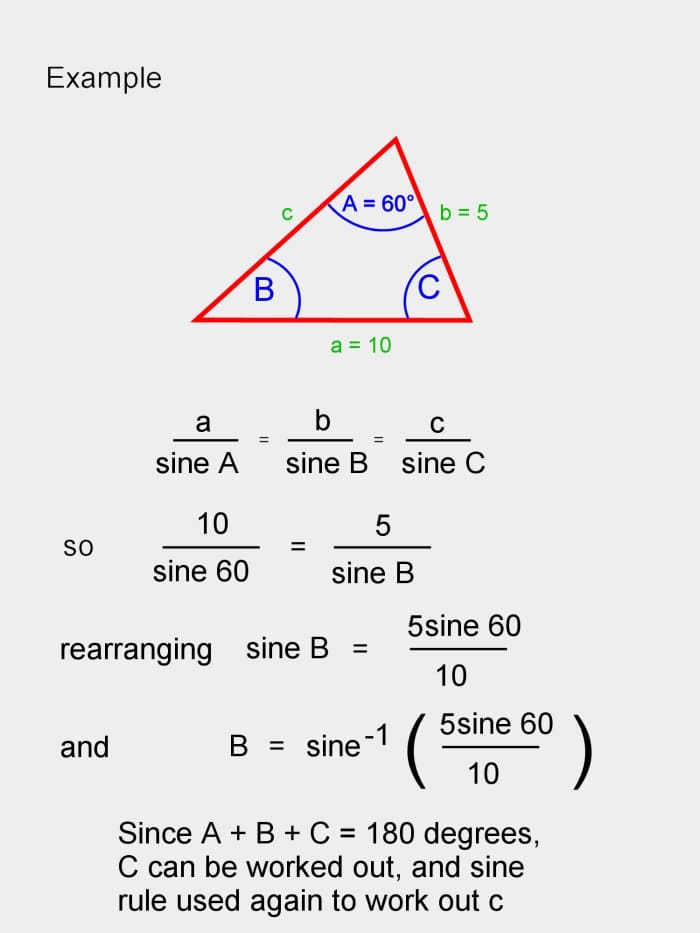
Case showing how to use the sine rule to calculate the unknown side c.
© Eugene Brennan
The Cosine Rule
For a triangle with sides a, b, and c, if a and b are known and C is the included angle (the angle betwixt the sides), C can be worked out with the cosine rule. The formula is as follows:
c = a ii + b 2 - 2ab cos C
When should the cosine rule exist used?
- You know the lengths of the two sides of a triangle and the included angle. Y'all can then piece of work out the length of the remaining side using the cosine rule.
- You know all the lengths of the sides only none of the angles.
Then, by rearranging the cosine rule equation:
C = arccos ((a 2 + b 2 - c 2) / iiab)
The other angles can be worked out similarly.
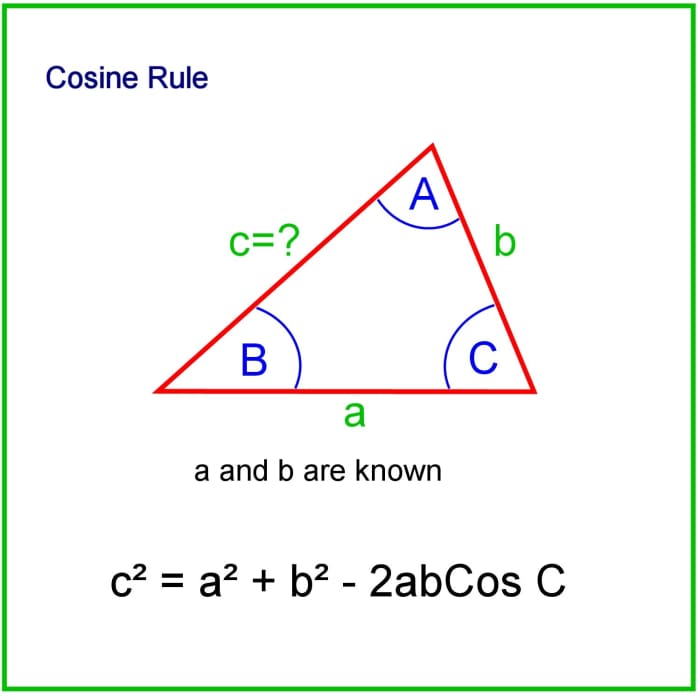
The cosine rule.
© Eugene Brennan
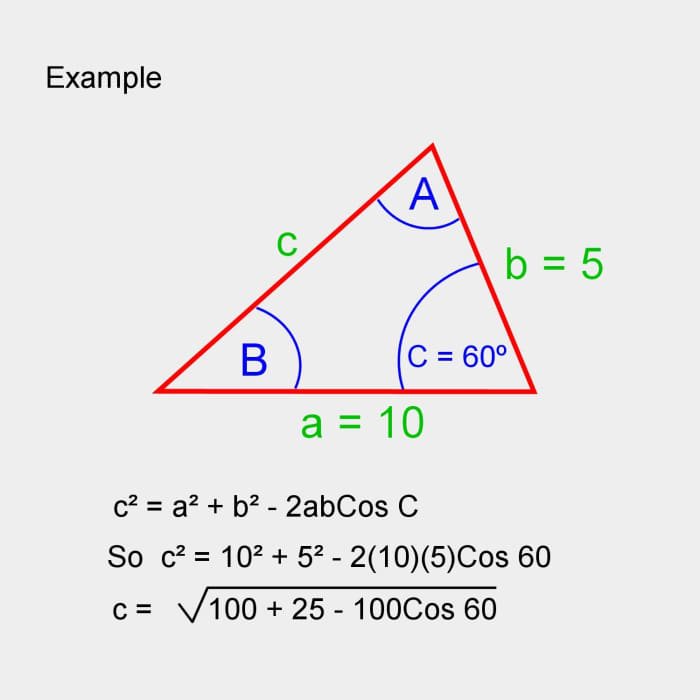
Example using the cosine rule.
© Eugene Brennan
How to Find the Angles of a Triangle Knowing the Ratio of the Side Lengths
If you know the ratio of the side lengths, you can employ the cosine rule to work out ii angles and so the remaining bending can be found knowing all angles add together to 180 degrees.
Case:
A triangle has sides in the ratio five:7:eight. Find the angles.
Answer:
So call the sides a, b and c and the angles A, B and C and presume the sides are a = 5 units, b = 7 units and c = viii units. It doesn't affair what the bodily lengths of the sides are because all similar triangles take the same angles. So if nosotros work out the values of the angles for a triangle which has a side a = 5 units, it gives us the result for all these like triangles.
Utilise the cosine rule. So c ii = a 2 + b two - twoab cos C
Substitute for a,b and c giving:
8² = v² + 7² - ii(5)(7) cos C
Working this out gives:
64 = 25 + 49 - 70 cos C
Simplifying and rearranging:
cos C = one/7 and C = arccos(one/7).
You tin can use the cosine dominion once more or sine rule to notice a second angle and the third angle tin be institute knowing all the angles add to 180 degrees.
How to Get the Area of a Triangle
There are three methods that tin can be used to observe the area of a triangle.
Method 1. Using the perpendicular height
The area of a triangle can be adamant by multiplying half the length of its base by the perpendicular superlative. Perpendicular means at right angles. But which side is the base? Well, you can use any of the three sides. Using a pencil, you tin can work out the area past drawing a perpendicular line from one side to the opposite corner using a set square, T-square, or protractor (or a carpenter's square if you're constructing something). Then, measure out the length of the line and use the following formula to become the expanse:
Area = 1/iiah
"a" represents the length of the base of operations of the triangle and "h" represents the height of the perpendicular line.
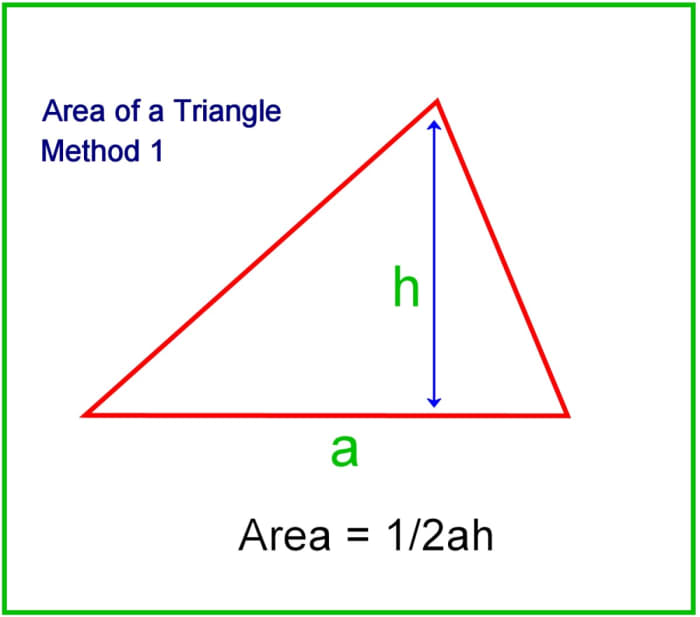
Working out the area of a triangle from the base of operations lengtth and perpendicular elevation.
© Eugene Brennan
Method 2. Using side lengths and angles
The simple method above requires y'all to actually measure the top of a triangle. If you know the length of two of the sides and the included angle, yous can work out the area analytically using sine and cosine (see diagram below).
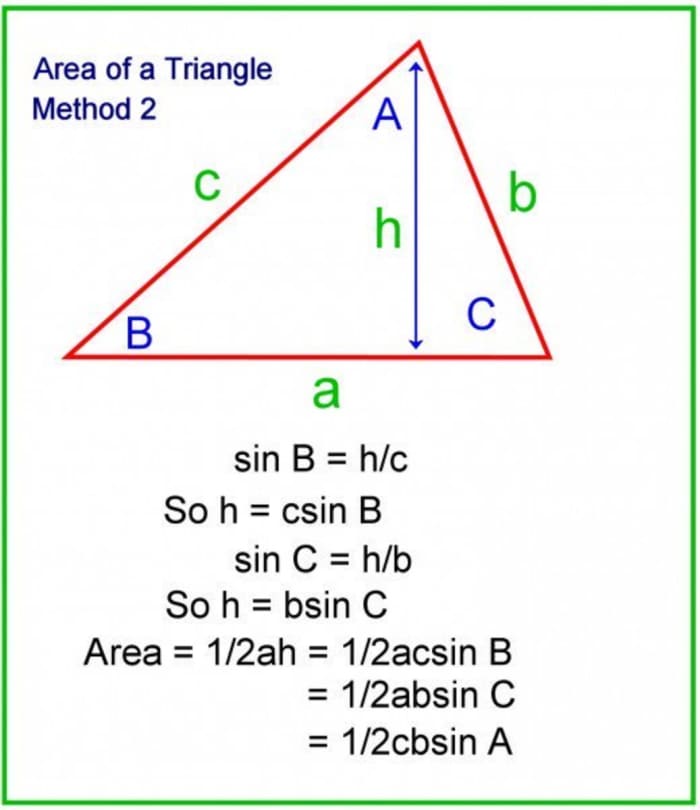
Working out the area of a triangle from the lengths of ii sides and the sine of the included angle.
© Eugene Brennan
Method 3. Use Heron's formula
All you need to know are the lengths of the three sides.
Area = √(s(due south - a)(due south - b)(s - c))
Where s is the semiperimeter of the triangle
southward = (a + b + c)/ii
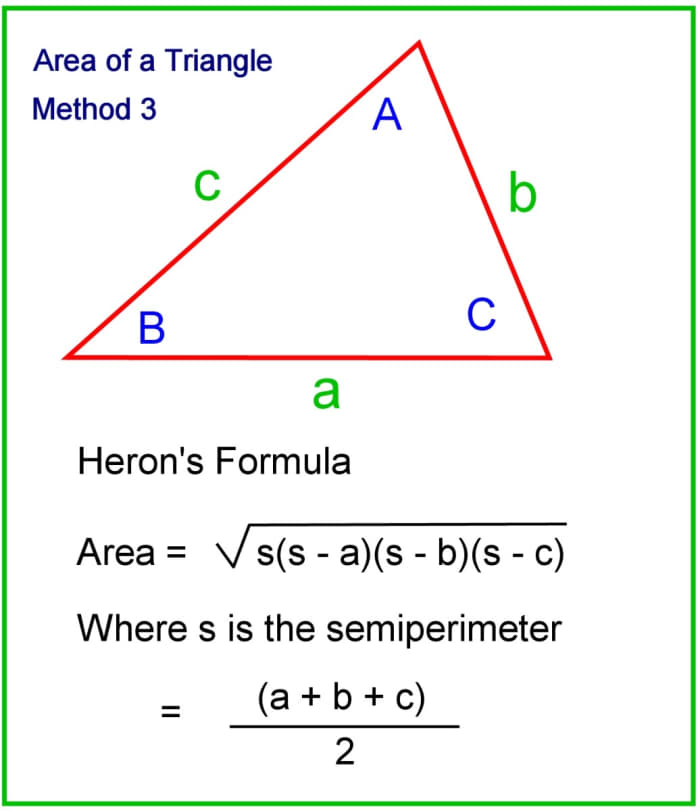
Using Heron's formua to work out the expanse of a triangle.
© Eugene Brennan
Summary
If y'all've fabricated it this far, you've learned numerous helpful methods to discover dissimilar aspects of a triangle. With all this information, you may be confused as to when you lot should use which method. The table below should help you lot place which dominion to use depending on the parameters you have been given.
Find the Angles and Sides of a Triangle: Which Rule Do I Use?
| Known Parameters | Triangle Type | Rule to Use |
|---|---|---|
| Triangle is right and I know length of ii sides. | SSS after Pythagoras's Theorem used | Use Pythagoras's Theorem to piece of work out remaining side and sine dominion to work out angles. |
| Triangle is right and I know the length of one side and one angle | AAS after third angle worked out | Use the trigonometric identities sine and cosine to work out the other sides and sum of angles (180 degrees) to work out remaining bending. |
| I know the length of two sides and the angle between them. | SAS | Use the cosine rule to piece of work out remaining side and sine rule to work out remaining angles. |
| I know the length of two sides and the bending opposite 1 of them. | SSA | Use the sine rule to work out remaining angles and side. |
| I know the length of one side and all iii angles. | AAS | Use the sine rule to work out the remaining sides. |
| I know the lengths of all three sides | SSS | Use the cosine rule in reverse to work out each bending. C = Arccos ((a² + b² - c²) / 2ab) |
| I know the length of a side and the angle at each terminate | AAS | Sum of 3 angles is 180 degrees and then remainging angle can be calculated. Use the sine rule to piece of work out the two unknown sides |
| I know the length of a side and i angle | You demand to know more information, either one other side or one other angle. Thes exception is if the known angle is in a rightangled triangle and not the right angle. |
FAQs Most Triangles
Below are some frequently asked questions about triangles.
What do the angles of a triangle add up to?
The interior angles of all triangles add up to 180 degrees.
What Is the hypotenuse of a triangle?
The hypotenuse of a triangle is its longest side.
What do the sides of a triangle add upwards to?
The sum of the sides of a triangle depends on the individual lengths of each side. Unlike the interior angles of a triangle, which always add together up to 180 degrees
How do you calculate the area of a triangle?
To calculate the area of a triangle, just use the formula:
Area = ane/twoah
"a" represents the length of the base of the triangle. "h" represents its height, which is discovered past drawing a perpendicular line from the base to the peak of the triangle.
How practise you detect the third side of a triangle that Is not right?
If y'all know two sides and the angle between them, use the cosine dominion and plug in the values for the sides b, c, and the bending A.
Next, solve for side a.
Then employ the angle value and the sine dominion to solve for bending B.
Finally, apply your cognition that the angles of all triangles add upwards to 180 degrees to discover angle C.
How practice yous find the missing side of a right angled triangle?
Use the Pythagorean theorem to observe the missing side of a triangle. The formula is equally follows:
ctwo = a2 + b two
c = √(a 2 + b 2)
What is the proper noun of a triangle with two equal sides?
A triangle with two equal sides and one side that is longer or shorter than the others is called an isosceles triangle.
What is the cosine formula?
This formula gives the square on a side contrary an angle, knowing the angle between the other two known sides. For a triangle, with sides a, b and c and angles A, B and C the iii formulas are:
a 2 = b ii + c ii - twobc cos A
or
b 2 = a ii + c ii - 2ac cos B
or
c 2 = a 2 + b two - twoab cos C
How to figure out the sides of a triangle if I know all the angles?
You need to know at least one side, otherwise, you can't work out the lengths of the triangle. At that place'due south no unique triangle that has all angles the same. Triangles with the aforementioned angles are similar but the ratio of sides for any two triangles is the same.
How to work out the sides of a triangle if I know all the sides?
Use the cosine rule in reverse.
The cosine dominion states:
c two = a 2 + b 2 - 2ab cos C
Then, by rearranging the cosine rule equation, y'all tin work out the bending
C = arccos ((a 2 + b ii - c 2) / 2ab)
andB
= arccos ((a two+ c 2 - b 2) / 2ac)
The third angle A is (180 - C - B)
How to find the perimeter of a triangle
Finding the perimeter of a triangle is a straightforward operation. The perimeter is equivalent to the added lengths of all three sides.
perimeter = a + b + c
How to detect the height of a triangle
Finding the height of a triangle is like shooting fish in a barrel if you lot have the triangle'southward area. If y'all're given the area of the triangle:
height = two x expanse / base of operations
If y'all don't have the area, but only take the side lengths of the triangle, use the following:
top = 0.5 x √ ((a + b + c)(-a + b + c)(a - b + c)(a + b - c)) / b
If you lot only have two sides and the angle betwixt them, try this formula:
area = 0.5 (a)(b)(sin(γ)), and then
height = area(sin(γ))
Triangles in the Real World
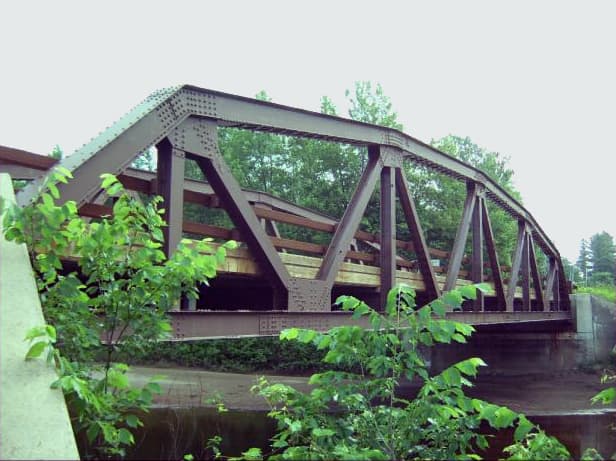
A triangle is the most basic polygon and can't be pushed out of shape hands, different a square. If yous await closely, triangles are used in the designs of many machines and structures because the shape is and then strong.
The force of the triangle lies in the fact that when any of the corners are conveying weight, the side opposite acts as a necktie, undergoing tension and preventing the framework from deforming. For instance, on a roof truss, the horizontal ties provide force and preclude the roof from spreading out at the eaves.
The sides of a triangle tin can besides human action as struts, but in this case, they undergo pinch. An case is a shelf subclass or the struts on the underside of an airplane fly or the tail fly itself.
How to Implement the Cosine Rule in Excel
You lot tin can implement the cosine rule in Excel using the ACOS Excel function to evaluate arccos. This allows the included angle to be worked out, knowing all three sides of a triangle.
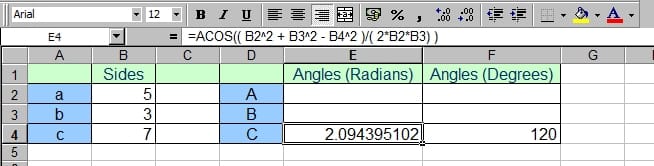
Using the Excel ACOS function to work out an bending, knowing three sides of a triangle. ACOS returns a value in radians.
© Eugene Brennan
How to Calculate Arc Length of a Circle, Segment and Sector Area
This content is accurate and true to the best of the author'southward knowledge and is not meant to substitute for formal and individualized communication from a qualified professional.
Questions & Answers
Question: How do y'all find the remaining sides of a triangle if you accept but one angle and 1 side given?
Answer: You need to have more information. Then either i side and the two angles at each finish or ii sides and the angle between them.
You tin can prove this to yourself by drawing out the single side and angle and seeing how you tin can draw as many different shaped triangles as y'all want.
Question: How practice I observe the value if all three sides of a scalene triangle are unknown?
Answer: If all the sides are unknown, you tin can't solve the triangle. You need to know at least two angles and one side, or two sides and one angle, or one side and i bending if the triangle is a right-angled triangle.
Question: What is the formula for finding what an equilateral triangle of side a, b and c is?
Answer: Since the triangle is equilateral, all the angles are 60 degrees. However, the length of at least one side must be known. One time yous know that length, since the triangle is equilateral, you know the length of the other sides because all sides are of equal length.
Question: How would you lot solve this problem: The angle of tiptop of the acme of a tree from bespeak P due west of the tree is 40 degrees. From a second betoken Q east of the tree, the bending of elevation is 32 degrees. If the altitude betwixt P and Q is 200m, detect the acme of the tree, right to 4 significant figures?
Respond: Ane angle is forty degrees, the other angle is 32 degrees, therefore the 3rd angle contrary the base of operations PQ is 180 - (32 + 40) = 108 degrees.
Y'all know i side of the triangle has length PQ = 200 m
A right angled triangle is formed between point P, the summit of the tree and its base of operations and also bespeak Q, the top of the tree and its base.
The all-time way to solve is to observe the hypotenuse of i of the triangles.
Then apply the triangle with vertex P.
Call the point at the top of the tree T
Call the acme of the tree H
The angle formed betwixt sides PT and QT was worked out every bit 108 degrees.
Using the Sine Rule, PQ / Sin(108) = PT/ Sin(32)
And so for the right angled triangle nosotros chose, PT is the hypotenuse.
Rearranging the equation to a higher place
PT = PQSin(32) / Sin(108)
Sin(twoscore) = H / PT
So H = PTSin(40)
Substituting the value for the hypotenuse PT we calculated to a higher place gives
H = (PQSin(32) / Sin(108)) x Sin(twoscore)
= PQSin(32)Sin(40)/Sin(108)
= 71.63 one thousand
Question: How do I observe the missing side of a triangle when only its pinnacle is known?
Respond: Use Pythagoras'south Theorem. Add together the sine, cosine and tan relationships between angles and the hypotenuse of the triangle to work out the remaining side.
Question: A greenhouse tin can be modeled as a rectangular prism with a half-cylinder on acme. The rectangular prism is twenty feet wide, 12 feet high, and 45 feet long. The half-cylinder has a diameter of 20 feet. To the nearest cubic foot, what is the volume of the greenhouse?
Answer: The volume of the rectangular prism section is:
Length x width x tiptop
= 45 x 20 ten 12 = 10800 cubic anxiety
The book of a cylinder is the cross-sectional area 10 length
The cross-sectional area is the area of a circle
Let R be the radius = twenty/2 = 10
and L be the length = 45
Expanse = πR²
Volume = πR²L
For a half cylinder
Volume = πR²L/2
= 3.1416 (10)² 10 45/2 = 7069 cubic feet to the nearest cubic human foot
Total volume = 7069 + 10800 = 17869 cubic anxiety
Question: What is the maximum and minimum value for the sine of an angle?
Answer: If θ is the angle, the maximum value of sine occurs when θ = ninety degrees or π/2 radians. The minimum value is -1 and this occurs when θ = 270 degrees or 3π/two radians.
Question: How do I know when to use the sine or cosine formula?
Reply: If you know the length of ii sides and the angle between them, so you tin use the cosine formula to piece of work out the remaining side. Otherwise, the sine formula or Pythagorean theorem can exist used.
Question: How practise you solve the side lengths (given merely their algebraic values - no numerical ones) and the 90 degree bending?
Answer: Use the sine rule, cosine dominion and Pythagoras theorem to express the sides in terms of each other and solve for the unknown variables.
Question: How do you find the length of all the sides of a correct triangle if all you know is Cos B is 0.75?
Reply: You can notice the bending B from the arccos of 0.75 and so utilise the fact that the 3 angles add upward to 180 to find the remaining angle. Withal there is an infinite number of similar correct triangles that have all three angles the same, so you need to know at least the length of one side.
Question: Which formula is used when given 90-degree triangle, reverse angle is 26 degrees and one leg is know?
Answer: Use the fact that the cos of an angle is the length of the adjacent side divided by the hypotenuse, or the sine of an bending is the opposite side divided by the hypotenuse. In your case, you know the side reverse the angle.
Then sine (26 degrees) = length opposite side / length hypotenuse
Therefore
Length hypotenuse = length opposite side / sine (26 degrees)
Utilize Pythagoras's theorem to work out remaining side
and remaining angle = 180 - (90 + 26) = 64 degrees
Question: How do I observe the angles of a triangle if I know the lengths of all 3 sides?
Answer: Use the cosine dominion to find one of the angles. You lot'll demand to use the arccos or inverse cos role to work out the value of the angle. So apply the sine rule to discover some other angle. Finally, apply the fact that the sum of the angles is 180 degrees to find the remaining third bending.
Question: How practise yous find the side of a right triangle given two angles and hypotenuse?
Respond: If you know two angles, and then you tin work out the 3rd since all the angles sum to 180 degrees. If the sides are a, b and the hypotenuse is c (opposite angle A), and the angles are A, B and C, then Sin A = a/c, so a = cSin A. Also Cos A = b/c, and so b = cCos A.
Question: What dominion would be used to find the length of sides if all three angles are known?
Reply: There is an infinite number of similar triangles that accept the aforementioned angles. Imagine if you have a triangle and you know all the angles. You can keep making it bigger, simply the angles stay the same. Withal, the sides go longer. And so yous need to know the length of at least one side. And then you can utilize the Sine Rule to piece of work out the remaining 3 sides.
Question: ABC is a triangle in which AB=xx cm and angle ABC =30°.Given that the surface area of the triangle is xc cm^2, find the length of BC ?
Answer: The formula for the area of the triangle is (1/2)AB X BCSinABC
Then rearranging:
BC = area / (1/2)ABSin(ABC)
= 2area / ABSin(ABC)
Plug in the values to work out BC:
BC = 2 x 90 / (20 x Sin xxx)
Question: How exercise you find an bending of an isosceles if y'all but know two sides and the surface area?
Respond: Let the triangle have sides of length a, b and c and angles A, B and C.
Angle A is opposite side a
Angle B is opposite side b
Angle C is opposite side c
The ii equal sides are a and b and the bending between them is C
Area = (ane/2)absinC
a, b and the area are known
And then sin C = area / ((ane/2)ab)
C = arcsin(area / ((1/ii)ab))
A + B + C = 180
But A = B
And so A + B + C = 2A + C = 180
And then A = (180 - C)/2
Employ the cosine rule to find length c
Question: How do I get the area of a scalene triangle if I take two sides and the angle betwixt them?
Answer: Use the formula 1/2abSinC where a and b are the two sides and C is the angle between them.
Question: If I have a i length of a triangle and the other angles how exercise I notice the missing length using the sine method?
Reply: Call the sides a, b and c and the angles A, B and C
a is known and also A, B and C
And so the sine rule says that a/Sin A = b/Sin B and rearranging gives b = (a/Sin A)Sin B
Similarly a/Sin A = c/Sin C and rearranging gives c = (a/Sin A)Sin C
Question: How should I approach the problem - The triangles ABC and ACD are such that BC- 32 cm, AD - 19cm, CD - 28cm BAC - 74 ( angle ) and ADC - 67 ( angle )?
Reply: Utilise the cosine rule to work out Air conditioning. Then the sine rule to work out the remaining angles/sides.
Question: How do I know when to use sine or cosine formula when given 2 degrees and i length?
Reply: If the length is opposite one of the known angles, you can use the Sine Rule. If it isn't, you can work out the third angle since the three angles sum to 180 degrees. And then employ the Sine Dominion. The Cosine Dominion is usually used when you only take one bending between 2 known sides.
Question: Each of the equal angles in an isosceles triangle measures 36 degrees. What is the measure of the tertiary angle?
Answer: All the angles in a triangle add up to 180 degrees. Both angles are 36 degrees and so that'due south 72 degrees. The remaining angle is 180 - 72 = 108 degrees.
© 2016 Eugene Brennan
Eugene Brennan (author) from Ireland on July 03, 2020:
Hi Jacob,
If yous two angles, you can calculate the third one considering all angles sum to 180 degrees. So you need at to the lowest degree one side length and you lot can use the sine rule to summate the others.
Jacob Halstead on July 03, 2020:
Finding lengths of a trisngle's sides using ii base of operations interior angles?
Eugene Brennan (author) from Republic of ireland on June 05, 2020:
Hi Swetha,
You need to know the length of at least one side. At that place are an infinite number of right angle triangles with the same 3 angles (like triangles).
If you know one side, you lot can use sine and cos to work out the other sides.
Swetha on June 05, 2020:
How to discover three sides when angles are given in a right angle triangle.Give a formula to solve it?
Eugene Brennan (author) from Ireland on June 02, 2020:
Hi Kayla,
Draw your triangle with the side 8cm as the base of operations. Phone call this a.
And then depict side c at an angle of 45.5 to side a starting at the left of a. This is angle B. You don't know it'southward length, so only continue on the line
Draw side b starting at the right of the base a. You don't know the length of b either, so simply go on information technology on to intersect side b.
Employ method 2 above for surface area to first observe the length of side c.
Then area = one/2 air conditioning sin B = 1/2 (eight) c sin 45.5 = 4c sin 45.v = 18.54 square cm
Rearranging gives c = 18.54 / (4 sin 45.v)
When you work out this value for c, y'all can use the cosine rule to find the length of the side b opposite the 45.five degrees angle. Now you know the lengths of all the sides so you tin utilize the sine dominion to work out the angles.
Kayla on June 01, 2020:
Can yu please explain this question?
A triangle has i side length of 8cm and an adjacent bending of 45.five. if the area of the triangle is eighteen.54cm, summate the length of the other side that encloses the 45.v angle
Cheers
Eugene Brennan (writer) from Ireland on May 13, 2020:
Hello,
And so call the sides a, b and c and the angles A, B and C and assume the sides are a = 5 units, b = vii units and c = 8 units. It doesn't matter what the actual lengths of the sides are considering all like triangles have the same angles. So if we piece of work out the values of the angles for a triangle which has a side a = five units, it gives us the result for all these similar triangles.
Use the cosine rule. So c² = a² + b² - 2abCos C
Substitute for a,b and c giving:
8² = 5² + 7² - 2(five)(7)Cos C
Working this out gives:
64 = 25 + 49 - 70Cos C
Simplifying and rearranging:
Cos C = one/seven and C = arccos(1/7).
You tin use the cosine rule again to find a second bending and the third angle tin be found knowing all the angles add to 180 degrees.
Hello on May xiii, 2020:
Can I notice sinus of the biggest or the smallest angle, if the simply thing I know is that the triangle is acute and it's sides are proportional to five:7:viii?
Eugene Brennan (author) from Ireland on May x, 2020:
Hi Abike,
No, because, in that location are an space number of combinations of angles for the other 2 angles or two sides.
Depict two lines with the known angle betwixt them. You'll see that you lot tin make the ratio of their lengths anything you lot want, changing the angles likewise so that one is large and the other small or vice versa.
Abike on May ten, 2020:
Hi,
Is it possible to find the angles of an astute triangle with merely one known bending and no known side?
Eugene Brennan (author) from Ireland on April 29, 2020:
Use the simple formula:
expanse = one/2 the base of operations 10 height
Multiply both sides of equation by 2
2area = ii ten i/2 x base of operations x height = base of operations by height
Divide both sides past peak
2area/height = base x acme/elevation = base
and switch around the ii sides
so base = 2area / pinnacle.
Suzy on April 28, 2020:
Find the length of the base. Where the peak is viii and the expanse is 20. Solve for the length base of operations?
Emmy on April 07, 2020:
Thank you then much!
Himanshu gond republic of india on March 12, 2020:
Thanks a lot sir
Eugene Brennan (author) from Ireland on February 27, 2020:
How-do-you-do Hassan, if we don't know the length of the side c, we need to know an additional slice of information, the angle between side a and b or one of the other angles.
Hassan on February 27, 2020:
Mr. Brennan, if we have just two side information for case a=5, b=x, and we know nothing near the angles then how to calculate c and any bending. the triangle is not right triangle.
Eugene Brennan (author) from Ireland on Feb 20, 2020:
No trouble Bob, glad to help! Take a bang-up twenty-four hours too!
Bob longnecker on February 20, 2020:
Mr. Brennan
Thank you very much. This is what I was looking for.
Have a smashing day and all-time regards .
Bob Fifty.
Eugene Brennan (author) from Republic of ireland on February 20, 2020:
How-do-you-do Bob,
The length of the brusque side is 3.half dozen" x tan(30) which works out at 2.08" approx.
If the angle changes to 31 degrees, the short side is three.half dozen" ten tan(31) = 2.16" approx.
So the length variation of the short side would vary with the tan of the angle. If you lot look at the graph of tan, in that location's an approximately linear variation up to almost 45 degrees (so the long side increases proportionately with the angle). Then the graph gets steeper at an increasing charge per unit, and so the short side would change a lot for pocket-sized variations of angle.
Bob longnecker on February xviii, 2020:
The three.6 side is opposite the 60° angle. The 3.vi side is the longest of the two short sides. I don't intendance almost the hypotinuse. But want to really see what a modify in the 30° angle does and how information technology affects the short side. First I need the length of that side and then the length of that side when I modify the 30° angle to 31°. How much does i° modify touch the length?
Eugene Brennan (author) from Ireland on February xviii, 2020:
In your first problem Bob, which bending is the 3.6" length opposite? (or is this side the hypotenuse, the longest side?)
Bob longnecker on February 17, 2020:
Yet trying simply no luck!
Eugene Brennan (author) from Republic of ireland on February 17, 2020:
You can also use a triangle calculator similar this one and all you lot accept to do is input values for side length and bending. If you accept sufficient information, it will calculate the remaining sides and angles.
https://world wide web.estimator.cyberspace/triangle-computer.htm...
Eugene Brennan (writer) from Republic of ireland on February 17, 2020:
If the triangle is right angled, then:
sine (angle) = length of side contrary bending / length of hypotenuse
Therefore length of side opposite angle = length of hypotenuse 10 sine(angle)
Similarly cos (angle) = length of side adjacent to angle / length of hypotenuse.
Therefore length of side adjacent to angle = length of hypotenuse 10 cos(bending)
Tan(angle) = length of side opposite bending/length of side next.
Then if you know all the angles (which you do), and one side, yous tin work out the remaining sides.
Bob longnecker on February 17, 2020:
Sorry to say I'm 77 years former. I took trig and calc as a senior in high school "60" years ago. Learning information technology taught me how to think and trouble solve in life dorsum and then but never used it Perdue after that. Forgot what I learned back so.
Do have a valid reason for the respond but don't accept the wear with all to go back and learn trig over again.
What I really need to know is how much B changes per degree of modify in the hypothesis. Example going from thirty to 31°how much increase in B length ? What is your calculated respond.
Sorry only too tired to get back and visit sixty years ago when I was 17!
Cheers and best regards,
Bob longnecker
Eugene Brennan (author) from Ireland on February 17, 2020:
Hello Bob, y'all tin use the sine, cos and tan relationships to work out bug like this.
Bob longnecker on February 17, 2020:
I have a triangle with angles of: xxx,60 and 90°. Side A is know to exist 3.six". I want to know what curt side B is. Can anyone give me the answer?
Problem #2.
I have a triangle with angles of 31, 59, and 90°. Long side A is three.half dozen". I want to know the length of short side B.
How-do-you-do on Feb 12, 2020:
solve two triangle and 4 triangle in quadrilateral by employ of sine rule
a/sin A= b/sinB that i know
But
a = sin A/ sinB what is that formula
I don't understand that formula merely that truthful
Duran on Jan 22, 2020:
Hi Mr. Brennan.
I have a trouble that is difficult for me:
Known:I have two angles:∠A and ∠B then I have a package of similar triangle-ABCs. At present there must be a betoken T inside the triangles who forms 3 new sides: TA, TB and TC. I know that the angles betwixt all these three sides are equally 120 deg.
Q: Can I solve the bending-BAT.
That realy confused me for a while !
Eugene Brennan (author) from Ireland on January 04, 2020:
If the angle is 45 degrees, the remaining angle is also 45 degrees, so the triangle is isosceles too every bit being correct angled. Then if the length of the hypotenuse is a and the other ii sides are b and c, so from Pythagoras's theorem:
a^ii = (b^2 + c^2) = (2b^2)
so b^2 = (a^2)/ii
and b = c = a / square root of two
Nathaniel Gloyd on January 04, 2020:
If y'all take a correct bending triangle, how would you discover the altitude from the corner of the ninety caste, to the hypotenuse on a 45 degree angle
Eugene Brennan (author) from Republic of ireland on December xix, 2019:
Hi Rj,
Use the sine rule.
So if your sides are a,b and c and yous know their lengths and your angles are A, B and C and you lot know one angle A, then:
a/sin A = b/sin B
Plow both sides of the equation upside down, then:
sin A / a = sin B / b
Multiply both sides by b
b sin A / a = sin B
Work out b sin A /a on your calculator and this gives you lot sin B.
Then take the arcsin of the result to get B. Once you take A and B, add together and subtract from 180 to become C.
Rj on Dec 19, 2019:
If one angle and all iii sides of the scalane triangle is given and then how will you go the mensurate of
other two bending
Eugene Brennan (author) from Ireland on October 24, 2019:
Hi Natalia,
Await at method 2 in the tutorial for finding the surface area of a triangle.
So the area is one/2 the product of ii sides multiplied by the sine of the angle between them.
In your question the sides are PQ and QR and the bending between them is PQR.
So area = (one/2) PQ sin PQR
Substitute for P, Q, bending PQR and the area:
xiv.ii = (1/2) x seven x 5 x sin PQR
Rearrange:
sin PQR = 14.two / ( (1/2) x seven x v )
Accept the arcsin of both sides. You lot tin do all this on a calculator, but take intendance entering all the brackets and numbers because it'southward very easy to make a error. Make certain the calculators is set to "DEG" and use the sin ^ -1 (usually shift on sin) to work out arcsin.
I would recommend HiPer Calc equally a good, free scientific computer app for Android if yous take a smartphone.
PQR = arcsin (14.2 / ( (1/2) x seven x 5 ) ) = 54.235° = 54° fifteen' approx
natalia on October 24, 2019:
HI EUGENE, can y'all solve this trouble for me and provide me with working out.
the area of triange PQR is 14.2cm squared, find angle PQR to the nearest minute, given PQ is 7cm and QR is 5cm.
Eugene Brennan (author) from Ireland on October 09, 2019:
How-do-you-do Pavel,
By diagonal, I presume you mean the hypotenuse.
So yous can use Pythagoras' Theorem.
The foursquare on the hypotenuse equals the sum of the squares on the other two sides.
Square the 2 sides and add together together:
(due north + 4)² + 16² = (n + 8)²
Aggrandize out:
n² + 8n + 16 + 256 = n² + 16n + 64
Rearrange and simplify:
8n = 208
Giving n = 26
Then the two sides are n + iv = thirty cm and n + 8 = 34 cm
Pavel on Oct 09, 2019:
I take a problem about a question can you lot help me please?
I have a correct angled triangle the bottom line is 16 cm the one on the side is n+4 and the diagonal line is n+8 can you lot aid me detect the two sides please?
Eugene Brennan (author) from Ireland on September 28, 2019:
How-do-you-do Carcada. You tin't. You lot can have as many triangles as you lot want with exactly the aforementioned three angles. These are called similar triangles. You need to know at least the length of 1 side, then you can use the sine rule to work out the others.
Carcada Keischa on September 28, 2019:
if only the angles of each side of the triangle is given then how can we find the length of each side of the triangle?
Eugene Brennan (author) from Ireland on September 08, 2019:
You don't take enough data. You demand to take at least 1 of a, c, A or C.
Sin B = one/ sqrt iii, but gives you the angle B = (acos (1/sqrt 3)). So if a is the base of operations, side c can be any length without knowing the other sides/angles.
Hannah Adams on September 07, 2019:
I take a question. How exercise I find the missing sides of a triangle if I know that sin B=1/sqrt three and a=2
Eugene Brennan (author) from Ireland on August 14, 2019:
tan (ɵ) = opposite / adjacent so opposite = adjacent ten tan (ɵ)
Now y'all know the opposite and adjacent sidfes, utilize Pythagoras' theorem to work out the hypotenuse.
Phoebe on August xiii, 2019:
Hey, i have a triangle, all that is known is the side by side, the right bending and the theta, how practise i effigy out the other sides,
asaba charles on July 23, 2019:
thanks
Maribel Gibbs from Paoli, Pennsylvania on May 22, 2019:
Wow, amazing! Ane of the all-time works I e'er have seen here!
Khaleel Yusuf on May 18, 2019:
A good review of many years of wining and dining with math calculations. Awesome!
Ur mum gay on April 24, 2019:
This is a decent website
Christopher on March 26, 2019:
Wow this is actually helpful thank you
Michael on January 20, 2019:
Hi,
I'm wrapping my head effectually this trouble: I know 1 side, and the two angles produced by the median on the opposing corner. I'd like to know the length of the other two sides. I drew a scheme, available here:
www.Stavrox.com/epitome/Triangle.png
The greenish values are known (a, alpha, beta) , I'd like to summate b, c and likewise x. Can yous help me.
Ferny Vise from San Francisco, CA on Jan 19, 2019:
I really like this article. As a math major myself, I believe math is cute!
Oscar Skabar on Dec 02, 2018:
I have an example I cannot work out..... Two birds sitting on a 90 degree mask 1 at 9m up & the other at 6m up but are 15m apart from each other, they see a fish in the h2o, how practice I calculate the distance of the fish from the birds then they are equal in altitude
Rodrigo on Nov 19, 2018:
Hi, Eugene! Y'all tin can calc the three angles inside a triangle using tangent one-half-bending like this:
tan(alpha/two) = r / (p-a)
tan(beta/2) = r / (p-b)
tan(gamma/2) = r / (p-c)
p = (a+b+c) / two (semiperimeter)
r = sqrt( (p-a)(p-b)(p-c) / p )
alpha + beta + gamma = 180 (they are the internal angles of the triangle :)
Congrats for your site!
Eugene Brennan (writer) from Republic of ireland on Nov eighteen, 2018:
Hi Carla. At that place may be a simpler mode of doing information technology, only you tin employ the cosine dominion in reverse to work out the bending B. Then since information technology's bisected, you know one-half this angle. Then employ the cosine rule in reverse or the sine dominion to work out the angle betwixt sides AB and CA. You lot know the third angle (between the bisector line and side CA) considering the sum of angles is 180 degrees. Finally use the sine rule again to work out the distance from A to the bisection point knowing the length of AB and half the bisected angle.
Eugene Brennan (author) from Ireland on November 05, 2018:
You lot tin't find side lengths with angles solitary. Similar triangles accept the same angles, but the sides are different. You must take the length of at to the lowest degree one side and two angles.
william on November 05, 2018:
how practice you lot find side lengths with simply angle measurements
Eugene Brennan (author) from Republic of ireland on November 03, 2018:
If you accept the angle at each finish, and so you tin work out the third angle because you know all the angles add up to 180 degrees. So utilise the sine rule to piece of work out each side (run across case higher up in the text)
Karen on November 02, 2018:
i accept the the length of i side and the angle at each end, what is the sum to work out the length of the other sides
Eugene Brennan (author) from Ireland on Nov 02, 2018:
Hi Tom,
If you know the lengths of all three sides, use the cosine rule first and the arccos role to piece of work out one of the angles. Then use the sine dominion (or the cosine rule over again) to work out the one of the other two angles and the fact that they add up to 180 degrees to find the final angle
Every bit regards Excel, I've added a photo to the article showing how to implement a formula for working out an angle using the cosine rule.
tom sparks on Oct 23, 2018:
I have a right angled triangle and know the lengths of all three sides. I would similar to summate the other angles.
I have tried TAN in Excel but it says using this 'Returns the tangent of the given angle,.
What would be the best fashion to work this out
Promise you can help
Kind regards
Eugene Brennan (writer) from Republic of ireland on October 21, 2018:
Y'all need more information, either another side or bending to solve.
Sanjeev on Oct 21, 2018:
Correct angle and h is 421.410
How discover 2 angles and two sides.
Eugene Brennan (writer) from Ireland on September 28, 2018:
You kneed to know at to the lowest degree one other angle or length. The exception is a right-angled triangle. If you know one angle other than the correct angle, then yous can work out the remaining angles using sine and cos relationships betwixt sides and angles and Pythagoras' Theorem.
SUDHAKAR Yard on September 28, 2018:
how to i find the length in a Scalene triangle? nosotros konw only i angle and one length.
Eugene Brennan (author) from Ireland on August 25, 2018:
If two sides are given and the angle between them, apply the cosine rule to find the remaining side, then the sine rule to find the other side.
If the angle isn't between the known side, use the sine rule to find the angles first, then the unknown side.
You at least need to know the bending between the sides or one of the other angles so in your instance it's the sine rule you demand to use.
Akhyar on Baronial 24, 2018:
If just two sides are given of a non correct angled triangle .. then how to notice angle between them
Eugene Brennan (author) from Ireland on July xix, 2018:
Hi Imran,
There'southward an infinite number of solutions for angles A and B and sides a and B. Draw it out on a piece of newspaper and you'll see that y'all can orientate side c with a known length (e.thousand. pick a length of 10 cm) and change the angles A and B to what e'er you desire.
You need to know either the length of one more side or one more angle.
Imran Hussain from Bharat on July 19, 2018:
Call the angles A,B and C and the lengths of the sides a, b and c.
a is contrary A
b is opposite B
c is opposite C
C is the correct angle = 90º and c is the hypotenuse.
How to observe the sides of triangle a and b and other 2 angles A and B, if i know just angle C and side c which is hypotenuse?
Eugene Brennan (author) from Republic of ireland on May 28, 2018:
Howdy Liam,
You need to know at least i of the sides.
You could have a very large or very pocket-size triangle with the same angles. These are called like triangles. See the diagram in the tutorial.
Liam on May 27, 2018:
How exercise I find a side in a right angle triangle if I know all three angles simply no sides?
Eugene Brennan (author) from Ireland on May 24, 2018:
If the holes are equally spaced around the imaginary circumvolve, then the formula for the radius of the circle is:
R = B / (2Sin(360/2N))
Where R is the radius
B is the distance between holes
N is the number of holes
Divya on May 24, 2018:
how to calculate altitude of each hole at PCD from eye circle
Amar36 on April 17, 2018:
Hello sir
how is that possible to know bending by just having ratios of two heights of triangle and u need non utilise protector or some other instruments and not even inverse trigonometric functions just simply past ratio practise we calculate them or not if then how
I asked it because how they have founded the angles of different triangles with it whatever discovery of changed trigonometric functions.
Thank in accelerate
Eugene Brennan (writer) from Ireland on February xiii, 2018:
No enough information shahid! If you call back well-nigh it, in that location's an space number of triangles that satisfy those conditions. Area = (1/ii) base x height. So there'south no unique values of base of operations and height to satisfy equation (1/2) base x height = 10 g squared.
shahid abbasi on February 13, 2018:
area of correct angle triangle is 10m and one bending is 90degree so how calculate three sides and some other two angles.
Eugene Brennan (writer) from Ireland on Jan xiv, 2018:
If y'all assign lengths to all sides, you easily tin work out the angles. Which sides did assign a length to?
Gem on January xiii, 2018:
Any luck Eugene? I accept figured out some of the angles by folding a part of the paper that can let me use trig to effigy it out if I assign each side a length.
Eugene Brennan (writer) from Ireland on Jan 07, 2018:
Hullo Danya,
Because you know two of the angles, the third angle tin simply be worked out by subtracting the sum of the two known angles from 180 degrees. Then use the Sine Rule described above to work out the two unknown sides.
danya61 on January 07, 2018:
Hullo
I take a triangle with ii known angles and ane known length of the side betwixt them, and there is no right angle in the triangle. I desire to calculate each of unknown sides. How tin can I do that? (The angle between unknown sides is unknown.)
Eugene Brennan (writer) from Ireland on January 04, 2018:
Describe a diagram jeevan. I tin't actually visualize this.
jeevan on Jan 04, 2018:
there are 3 circles one large circle is a pitch circumvolve having 67 diameter and medium circle is fatigued on the circumference of pitch circle at the bending of v degree hvaing xi.04 radius and a pocket-sized circumvolve with only moves in 10 y direction on pitch circle radius having ane.five radius so if the medium circle is moved 5degree then at which indicate the small circle is coinciding and the distance from small-scale circle to center of large/pitch circle.?
sir please assist me finding the answer thanks.
Gem on Dec 29, 2017:
It is tough to prove for sure. I thought I had it by assigning each side a random length ( such as 2cm) and then taking the middle point equally half, which looked similar the right angle triangle on the elevation right paw side was half of the one-half. Merely it still tin can't be proven to exist half because of the fold.
Eugene Brennan (author) from Ireland on December sixteen, 2017:
If information technology's an equilateral triangle, the sides and angles tin exist hands worked out. Otherwise the triangle can take an infinite number of possible side lengths as the apexes A and C are moved around. And so if none of the magnitudes of lengths are known, the expression for lengths of sides of the triangle and its angles would accept to exist expressed in terms of the square's sides and the lengths AR and CP?
Gem on December 15, 2017:
The whole problem has no measurements or angles. It only has angle names such as A,B,C,D etc. My starting point is from the common knowledge that a square has 4 x 90 degree angles. If I could make up one's mind one other angle then I could figure out the whole trouble by using the 180 degree rule of triangles. I will snap a moving picture of it and try and upload it hither on Monday, or sketch and upload it. Information technology seems to be a existent stumper, two/seventy people at a workshop were able to figure information technology out, as I was told past the person who passed information technology along to me. I appreciate your reply, and I await frontward to sharing the appropriate visual information with y'all.
Eugene Brennan (author) from Ireland on December 15, 2017:
Hi Precious stone,
Is any information given about where the corners of the triangle affect the sides of the foursquare or the lengths of the square'due south sides? If the triangle isn't equilateral (or even if information technology is), it seems that in that location would exist an infinite number of placing the triangle in the foursquare.
Gem on December 14, 2017:
Trouble: A triangle is placed inside a square. The triangle doesn't have measurements or any listed angles. So we can't place the blazon (although it looks equilateral) or brand any physical assumptions virtually the triangle. I'thou suppose to effigy out the angles of the triangle without a protractor or ruler based on the only angles I am given which are the 90 degrees from each corner of the square it'southward in. Since the lines that cut through the square from the principal triangle within the square brand new sets of smaller triangles, I still can't make out costless or supplementary angles since most of those smaller triangles aren't definitely correct angles isosceles triangles.
I'm not certain if my question is clear, so if you answer back I'll endeavor and add a picture or sketch to clarify.
But picture a foursquare with a triangle in it touching all 3 sides of its points to the square with no units of measure and no angles. Nosotros tin only assume that the square has 90 degree angles in the corners and that's all we are given to work with.
Cheers Precious stone
Eugene Brennan (author) from Ireland on December 01, 2017:
Hi Maxy,
Phone call the angles A,B and C and the lengths of the sides a, b and c.
a is opposite A
b is contrary B
c is reverse C
C is the correct bending = 90º and c is the hypotenuse.
If the bending A is known and the side opposite it, a, is known
And so Sin A = opposite/hypotenuse = a/c
So c = a/Sin A
Since you know a and A, you tin can piece of work out c.
Then employ Pythagoras's theorem to work out b
c² = a² + b²
And so b² = c² - a²
And then b = √(c² - a²)
If the angle A is known and the side side by side to information technology, b, is known
Then Cos A = adjacent/hypotenuse = b/c
Then c = b / Cos A
Since you know b and A, you tin can work out c.
Then utilize Pythagoras's theorem to work out a.
c² = a² + b²
So a² = c² - b²
So a = √(c² - b²)
Eugene Brennan (author) from Ireland on November 27, 2017:
Y'all need to use the cosine dominion in contrary.
So if the angles are A, B, and C and the sides are a,b and c.
Then c² = a² + b² - 2abCos C
Rearranging gives bending C = Arccos ((a² + b² - c²) / 2ab)
You can work out the other angles similarly using the cosine dominion. Alternatively use the sine dominion:
So a/Sin A = c/Sin C
So Sin A = a/c (Sin C)
and A = Arccos ( a/c (Sin C) )
and similarly for the other angles
Hannah on November 27, 2017:
How exercise y'all find the angle if all iii sides are given
Eugene Brennan (author) from Ireland on November 25, 2017:
Polygons are a lot more complicated than triangles because they can have any number of sides (they do of course include triangles and squares). Also polygons tin be regular (have sides the same length) or non-regular (have unlike length sides).
Here'south two formulae:
For a regular or non-regular polygon with n sides
Sum of angles = (n-2) x 180 degrees
For a regular convex polygon (not like a star)
Interior angles = (1 - two/north) 10 180 degrees
Eugene Brennan (author) from Ireland on November 23, 2017:
Howdy Jeetendra,
This is called a scalene triangle. The longest edge of whatever triangle is opposite the largest bending. If all angles are known, the length of at to the lowest degree one of the sides must be known in order to observe the length of the longest edge. Since you know the length of an edge, and the angle opposite it, you tin use the sine rule to work out the longest edge. So if for example y'all know length a and angle A, then yous can work out a/Sin A.
If c is the longest side,
then a/sin A = c/Sin C ,
then rearranging,
c = a Sin C / Sin A
a, C and A are known, so you can work out c
Jeetendra Beniwal( from Bharat) on November 23, 2017:
If all three angles are given then how we discover largest edge of triangle,if all angles are acute
Eugene Brennan (author) from Republic of ireland on July 21, 2016:
Thanks Ron, triangles are great, they crop up everywhere in structures, machines, and the ligaments of the homo body tin be thought of as ties, forming one side of a triangle.
Ron Bergeron from Massachusetts, The states on July 21, 2016:
I've always found the math behind triangles to be interesting. I'm glad that you ended the hub with some examples of triangles in every day use. Showing a applied use for the data presented makes it more than interesting and demonstrates a purpose for learning about it.
henryyousuponchis.blogspot.com
Source: https://owlcation.com/stem/Everything-About-Triangles-and-More-Isosceles-Equilateral-Scalene-Pythagoras-Sine-and-Cosine#:~:text=Facts%20About%20Triangles-,A%20triangle%20is%20a%20polygon%20with%20three%20sides.,would%20then%20become%20straight%20lines.

Postar um comentário for "What Do the Sides of a Triangle Add Up to"