2012 Irc Versus 2012 Ibc 4 Story Single Family
As mentioned in the previous article, Seismic Assay: UBC 97 provisions, the seismic assay in the pattern of buildings especially high ascension towers is a very important gene to consider. Because earthquake loads together with the wind loads have a huge impact on the design issue. In fact, nigh of the building design results were govern with the seismic loads. Calculating the seismic forces can be determined using the seismic parameters specified past the code. These parameters can be found on the seismic blueprint codes available such every bit ASCE vii, IBC and UBC-97. Although these codes are recommended code to utilize in seismic, the use of these codes is nevertheless depending on the local authorities from where the project is located.
This commodity is a comparison with the previous commodity Seismic Analysis: UBC 97 provisions, we will tackle the Seismic Assay provisions as specified in ASCE-7 and IBC. We will summarize the different seismic parameters that we ofttimes utilize in the Seismic Assay according to ASCE and IBC. These parameters are specified below; most of the images hither are an extract from the ASCE-seven and IBC-12.
Risk Category and Seismic Importance Factor
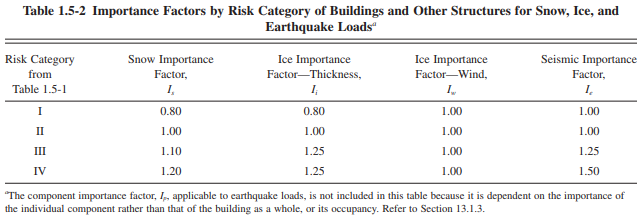
The kickoff thing to consider is to identify the chance category and seismic importance factor of the project according to the nature of occupancy. Nosotros tin can base the risk category on Section 1604.5 of the International Edifice Code (IBC) 2012, Tabular array 1604.5 "Gamble Category of Buildings and Other Structures". Nosotros can easily identify the risk category of the said table co-ordinate to the Table 1604.5 below. And from the chance category identified in Table 1604.5, the seismic importance cistron, Ie, tin can be found in Table 1.5-two of ASCE 7-ten below.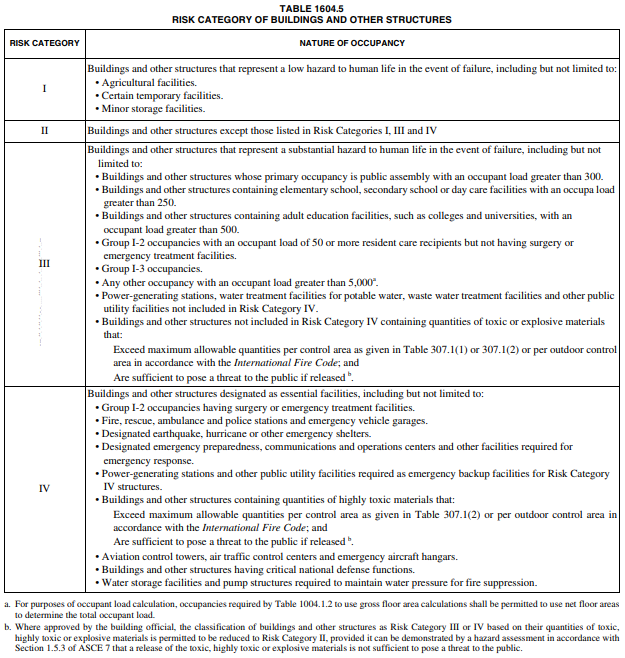
Site Coefficients
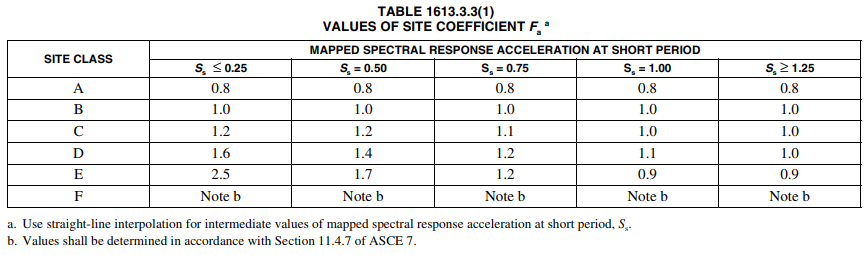
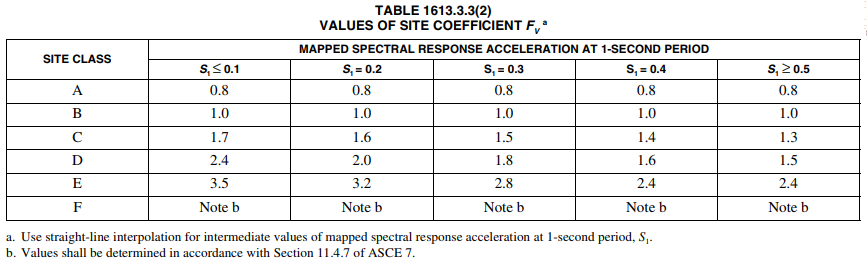
A site coefficient, Fa, and Fv should be defined likewise. The site coefficients, Fa and F5, can be establish from Tables 1613.3.three(1) and 1613.three.iii(2) of the International Building Lawmaking (IBC) 2012 respectively. Table 1613.3.3(1) requires knowing the site class of the structural building location and the mapped spectral response acceleration at brusque periods, SS. Tabular array 1613.three.3(two) requires knowing the site class of the structural building location and the mapped spectral response acceleration at the i-second period, S1.
Conclusion of S MS, S M1, S DS, S D1
S MS is the mapped maximum considered earthquake spectral response acceleration for curt periods adapted for site form effect. It can be determined co-ordinate to Equation xvi-37 of the International Edifice Lawmaking (IBC) 2012, which is equal to the site coefficient, Fa, multiplied by the mapped maximum considered earthquake spectral response acceleration for short periods, SSouth.
Southward M1 is the mapped maximum considered earthquake spectral response acceleration for 1-second menses adapted for site class effect. According to Equation xvi-38 of the International Building Lawmaking (IBC) 2012, it is equal to the site coefficient, Ffive, multiplied past the mapped maximum considered earthquake spectral response dispatch for the one-2d period, S1.
SDS is the design spectral response acceleration coefficient for short period. Information technology can be calculated according to Equation 16-39 of the International Building Lawmaking (IBC) 2012, which is equal to 2-thirds multiplied by the mapped maximum considered convulsion spectral response acceleration for short periods adapted for site class issue, SMS.
S D1 is the design spectral response acceleration coefficient for the ane-second period. Equation xvi-40 of the International Edifice Code (IBC) 2012 tells united states that it is equal to 2-thirds multiplied past the mapped maximum considered convulsion spectral response dispatch for the 1-2nd period adjusted for site form effect, SM1
Seismic Design Category, SDC
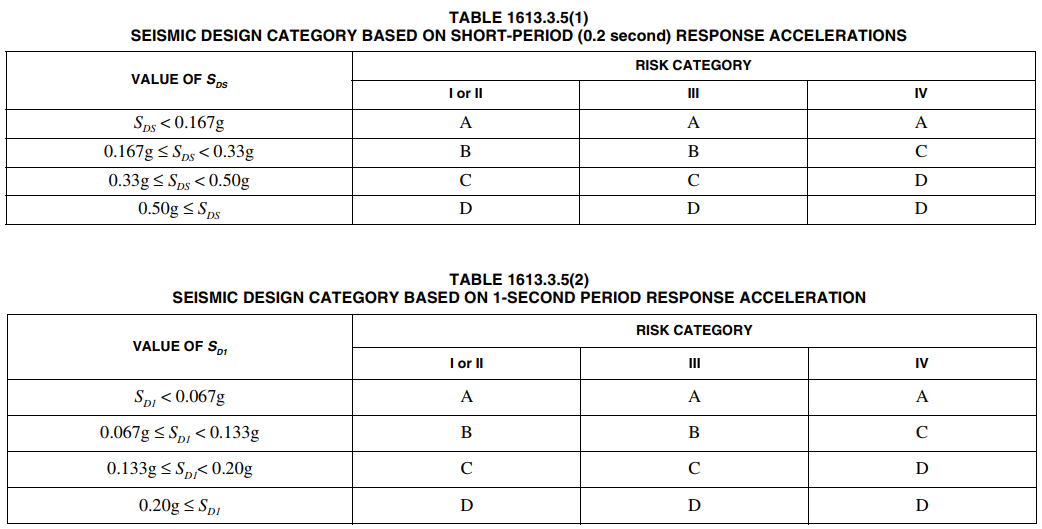
To make up one's mind the appropriate seismic design category refer to Tables 1613.iii.5.(1) and 1613.3.5.(2) of the International Building Code (IBC) 2012 as per the figures below.
Response Modification Factor, R
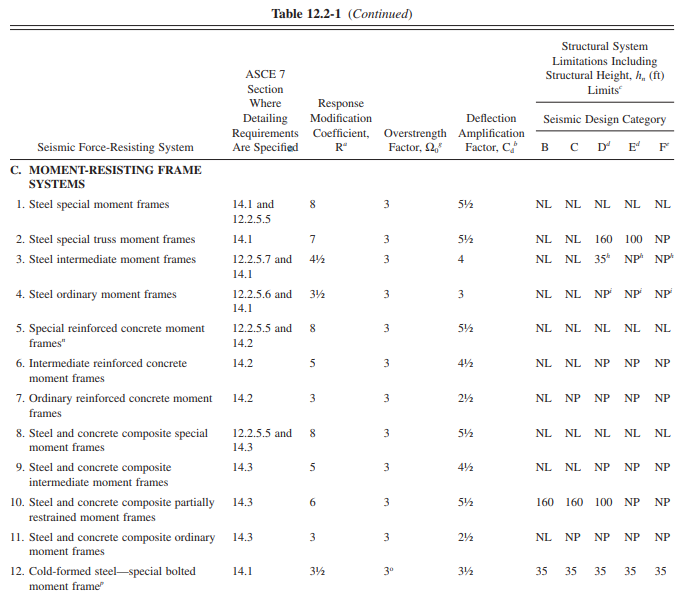
Response modification gene, R, is besides required and tin can be determine using figure Table 12.2-1 of ASCE 7-10 below.
Elastic Fundamental Catamenia, Ta
To make up one's mind the elastic primal period of the edifice, apply the Equation 12.8-7 of ASCE 7-10 can be simplified as follow.
Seismic Response Coefficient, C s
The seismic response coefficient, C s , is based on Equation 12.viii-2 of ASCE 7-ten. The seismic response coefficient is equal to design spectral response dispatch coefficient for brusque flow, S DS , times the seismic importance factor, I east , divided by the response modification cistron, R.
Effective Seismic Weight
The effective seismic weight of the structural building should likewise be calculated. This is equal to the number of edifice stories multiplied past the weight of each edifice story.
Calculation of Seismic Base Shear
The base shear, V. tin can be calculated as per the Equation 12.8-1 of ASCE vii-10, which is equal to the seismic response coefficient times the constructive seismic weight.
Notice Distribution Exponent, k
Finding the distribution exponent, k according to Section 12.eight.3 of ASCE 7-10, the distribution exponent is equal to i.0 for buildings with an elastic primal period less than or equal to 0.v seconds and is equal to 2.0 for buildings with an rubberband fundamental menses greater than or equal to 2.5 seconds. For structures having an elastic fundamental period between 0.5 seconds and 2.5 seconds, we volition use linear interpolation to notice the distribution exponent.
Nosotros demand also to summate a parameter for each edifice story equal to the weight of each story multiplied past the pinnacle from the base to the story to the power of the distribution exponent.
Vertical Distribution Factor, C VX
The vertical distribution factor, Cvx, is equal to the percentage of base shear that is assigned to each floor level. The formula for base shear is given in Equation 12.8-12 of ASCE 7-10 beneath.
Determine Seismic Lateral Force for Each Level , F 10
Co-ordinate to Equation 12.8-11 of ASCE 7-10, the lateral force at each level of the edifice is equal to the vertical distribution factor for each level multiplied by the seismic base shear which can be simplified as:
Seismic Story Shear , V X
The seismic story shear, Five10, is according to Equation 12.8-13 of ASCE vii-10.
Overturning Moment, M X
Overturning Moment is likewise required to exist calculated.
Find Deflection Amplification Gene , C d
The amplification gene, Cd, is according to Table 12.two-1 of ASCE 7-10 beneath.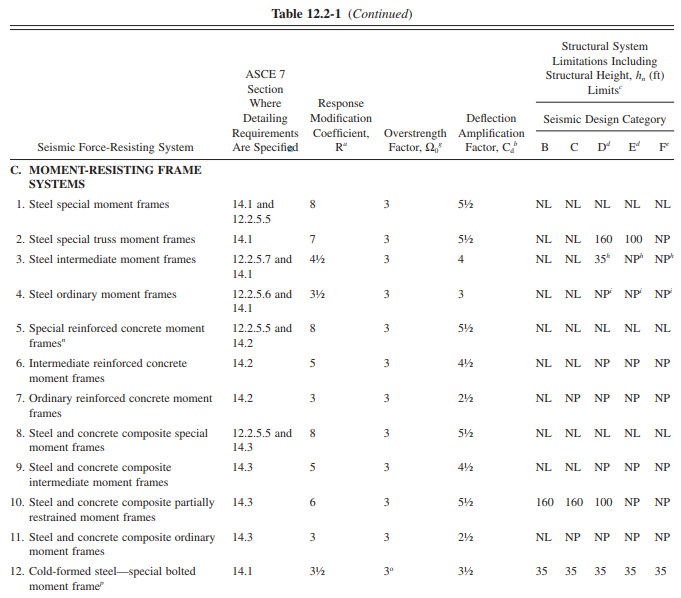
Lateral Deflection at Each Level
Based on Equation 12.viii-fifteen of ASCE vii-10, it is equal to the deflection amplification cistron times the rubberband lateral deflection at each level nether seismic lateral forces divided by the seismic importance factor.
Stability Coefficient
Evaluate the stability coefficient for each level per Equation 12.eight-16 of ASCE 7-10. Information technology is equal to the total un-factored vertical blueprint load at and above each level times the design story shift times the seismic importance factor divided by the product of design story shear, story top below the level in consideration, and deflection amplitude cistron. The maximum value for stability coefficient is institute using Equation 12.viii-17 of ASCE 7-10. According to Section 12.8.vii of ASCE 7-10, if the stability coefficient is less than 0.1 for all flooring levels, so P-delta furnishings don't have to be considered.
Further calculation checks should exist performed on the post-obit accordingly:
- Design Story Drift:Calculate the pattern story drift which is equal to the difference in deflections of the centers of mass of any two adjacent stories.
- Un-factored vertical design load, Px:The total un-factored vertical design load at and above each level should be calculated.
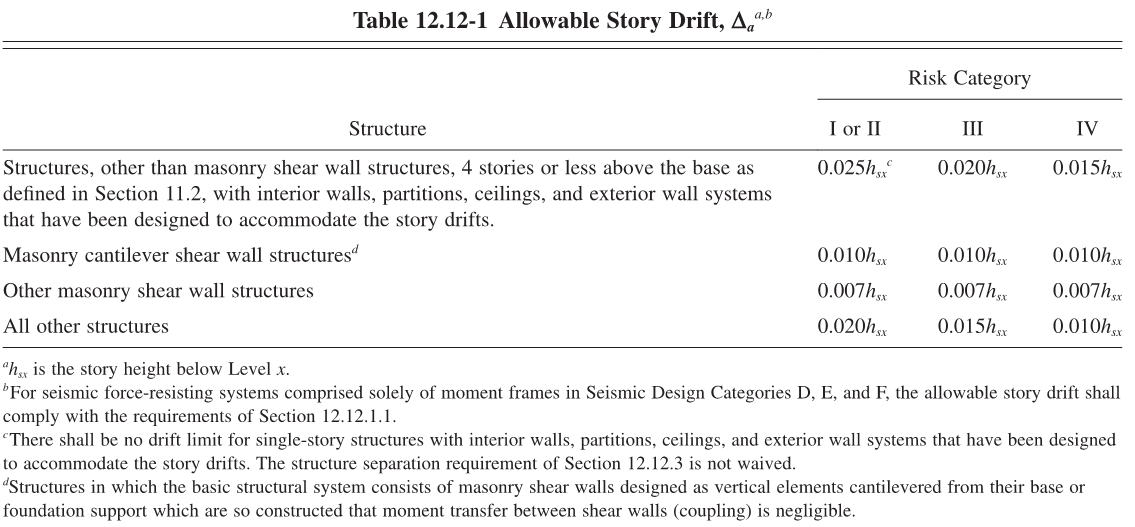
- Check Design Story Migrate:The commanded story drift tin exist constitute from Table 12.12-i of ASCE 7-ten as shown on the figure below. The commanded story drift should be greater than or equal to the blueprint story drifts for each flooring level.
The author strongly suggests to have you a full copy of ASCE-7 and IBC 2012 pattern codes when doing a seismic assay. The in a higher place are guidelines simply for the reader to easily locate the parameters needed in the seismic analysis using ASCE and IBC codes.
What do you think of the above this commodity? Tell u.s. your thoughts! Go out your message in the annotate section below. F eel gratis to share this article, subscribe to our newsletter and follow us on our social media pages.


14,634 full views, 16 views today
 Copyright secured by Digiprove © 2018-2019 The Structural Earth
henryyousuponchis.blogspot.com
Source: https://www.thestructuralworld.com/2018/11/07/seismic-analysis-asce-7-and-ibc-2012-provisions/

Postar um comentário for "2012 Irc Versus 2012 Ibc 4 Story Single Family"